Pahlé India Foundation (PIF)’s Three-pronged Strategy
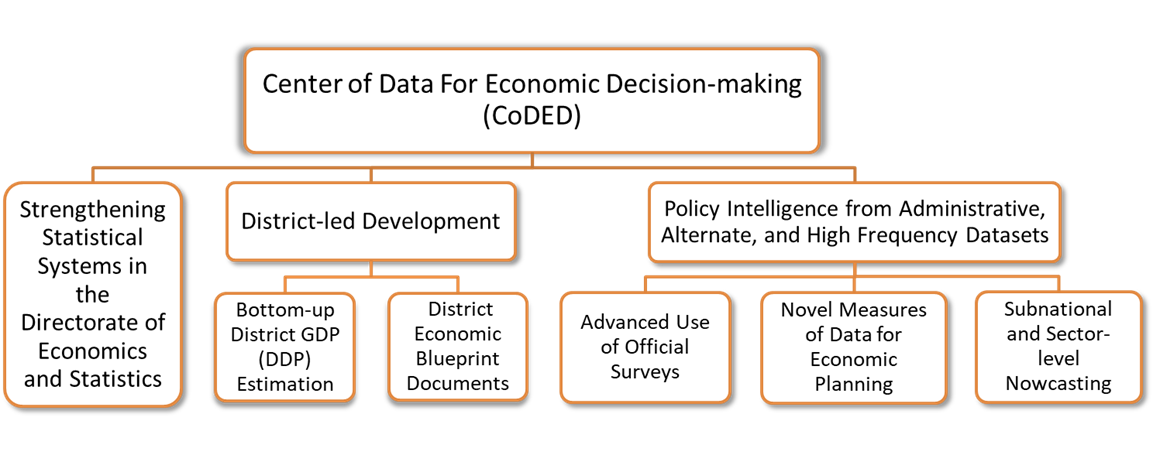
PIF’s CoDED follows a three-pronged strategy to actualize this vision:
1. Strengthening Statistical Systems in DES
Most states depend on the Directorate of Economics & Statistics (DES) to produce their economic data, but DES often lacks the staff, tools, and systems needed to generate accurate and timely information. Administrative data arrives late or in poor shape, methods are outdated, and district figures are usually rough estimates rather than real measurements. This leaves states planning with weak or incomplete evidence. The CoDED fixes this by strengthening DES from the inside out: cleaning and organising data, modernising processes, training officers in updated methods, and helping put in place simple, reliable systems that consistently produce high-quality state and district numbers. In short, CoDED turns DES into a dependable source of economic intelligence that governments can actually use for planning and decision-making.
2. District-led Development
The second pillar empowers districts to generate and act upon their own economic data.
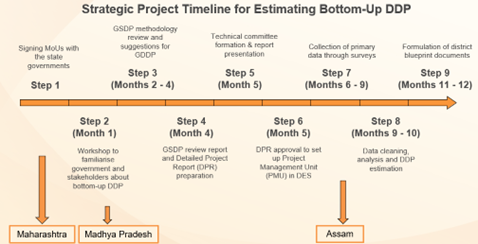
2.1. Bottom-up DDP Estimation:
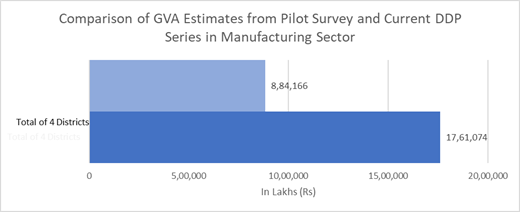
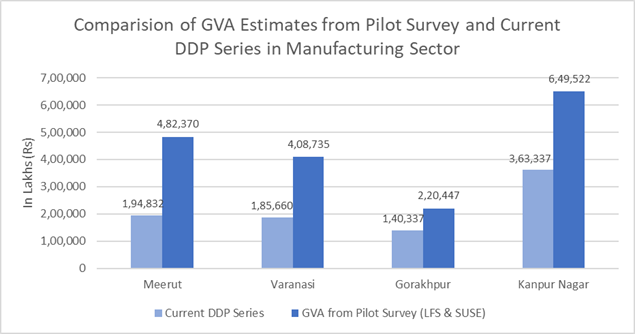
The current GDP apportionment process flows top-down: national à state à district, based on national ratios that rarely capture on-ground realities. CoDED inverts this method by proposing a bottom-up estimation of District Domestic Product (DDP) through three primary surveys:
Annual Survey of Industries (ASI) to capture organized manufacturing,
Labour Force Survey (LFS) to estimate secondary sector value added, and
Annual Survey of Unincorporated Enterprises (ASUSE) for tertiary sector insights.
This approach not only creates a more accurate baseline but also enables real-time tracking of key performance indicators (e.g., labor force participation rate).
2.2. District Blueprints and Economic Planning:
District blueprints are developed using PIF’s TSP3 framework, which moves from Target Setting to SWOC Analysis, then to Pathway Design, and finally the identification of three key growth drivers. Targets are set for each district’s GDDP and sectoral growth. A stakeholder-led SWOC analysis maps local strengths, weaknesses, opportunities, and constraints. The Pathway Design stage creates a sequenced roadmap of necessary reforms, priority projects, and resource allocation. The process concludes by selecting three high-impact growth drivers per district, based on inputs from District Collectors and stakeholder inputs along with DDP data, to focus efforts and achieve measurable development outcomes.
3. Alternate & High-Frequency Data Systems
Even with stronger systems and bottom-up DDP, states still lack timely economic intelligence because official GDP and GSDP arrive with long delays. CoDED addresses this by integrating fast-moving, high-frequency data, such as electricity use, GST collections, night-time lights, mobility trends, digital payments, and feeder-level power data, into planning. These indicators track real activity far more quickly than traditional statistics. Using them, CoDED builds subnational and sectoral nowcasting systems that estimate current economic conditions before official releases and reveal district-level trends in real time. PIF’s nowcasts have already shown high accuracy nationally and in Maharashtra. With monthly estimates, continuously updated models, and automated dashboards, states gain real-time visibility and can respond to shocks and opportunities as they unfold.
Together, these interventions transform how India plans, monitors, and delivers growth: bottom-up, state- and district-first, and future-ready.