DPrP 2011 versus DPrP 2018
The Defence Production Policy (DPrP) 2011 was issued by the Department of Defence Production (DDP), Ministry of Defence (MoD). It outlines the framework within which domestic industries are expected to pursue indigenous design and manufacture of defence equipment.The policy recognises Micro, Small andMedium Enterprises (MSMEs) as an integralpart of the defence production supply chains. As…
Re-Making Make in India
Data released by Ministry of Commerce shows a worsening of India’s trade deficit by almost 45%, rising from USD 106.2 billion in FY 17 to USD 156.83 billion in FY 18. While imports during the fiscal grew at around 19.59%, exports showed a muted growth rate of less than 10%. This slowdown in India’s foreign…
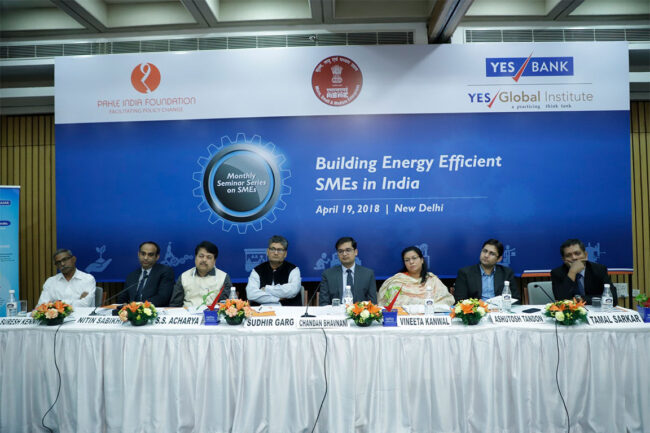
Building Energy Efficient SMEs in India, New Delhi
The eighth seminar of the “PIF-YGI Monthly Seminar Series on MSMEs” was held in New Delhi on the 19th April 2018. Ms Gunja Kapoor, Associate Fellow, Pahle India Foundation made the introductory remark at the session. The panellists at the seminar included Shri Sudhir Garg, Joint Secretary, Development Commissioner, Ministry of Micro, Small & Medium…
Caveats in the Financial Resolution and Deposit Insurance Bill
The Finance Resolution and Deposit Insurance (FRDI) bill was introduced in Parliament during theBudget Session of 2017 and has been due to be passed since then. The work of establishing a framework for financial resolution and deposit insurance started with the Financial Sector Legislative Reforms Committee (FSLRC) report which came out in 2013, but progress…
The Need for a Regulatory Sandbox
While India has had an average savings rate of more than 30 per cent during the eleventh and twelfth five-year plans, the overall savings rate is on the wane of late (see Figure 1). The trend of household savings is no different. Also, gross household financial savings as percentage of gross national disposable income (GNDI)…
A rather slow progression?
Indian policymakers realized the importance of revamping the land records management system during the latter half of 1980s. Since then, there have been various modernization programmes directed towards updating and computerizing the existing land records, digitizing all the cadastral maps, simplifying the process of transfer and registering of property. The first of these centrally-funded programmes…
Stalled Projects – An Update
The latest data released by CMIE shows that the value of stalled projects have risen from INR 9.66 trillion in 2015 to INR 13.22 trillion in September 2017.CMIE’s capex database is used as a leading indicator for tracking the health of India’s economy which, in turn, acts as an incentive for capacity expansion by new…
Why taxing long term capital gains tax is not the best idea
The government had been proactive in improving the business environment in India through programs like ‘Make in India’ and ‘Startup India’ which have paid decently. The clear testimony of this being the jump in FDI inflows and the uptake of government’s Learning &Development (L&D) module. FDI inflows grew more than 48% in the 12 months…
High CorporateTax Ratesin India – A Key Impediment to Foreign Investments
Corporate tax rate is an important factor in determining the attractiveness of a country for foreign investment.Other things being equal, investments are likely to be larger in countries that have a relativelylower corporate tax rate. This probably is the case with India. Although India is one of the fastest growing economies and has a higher…