

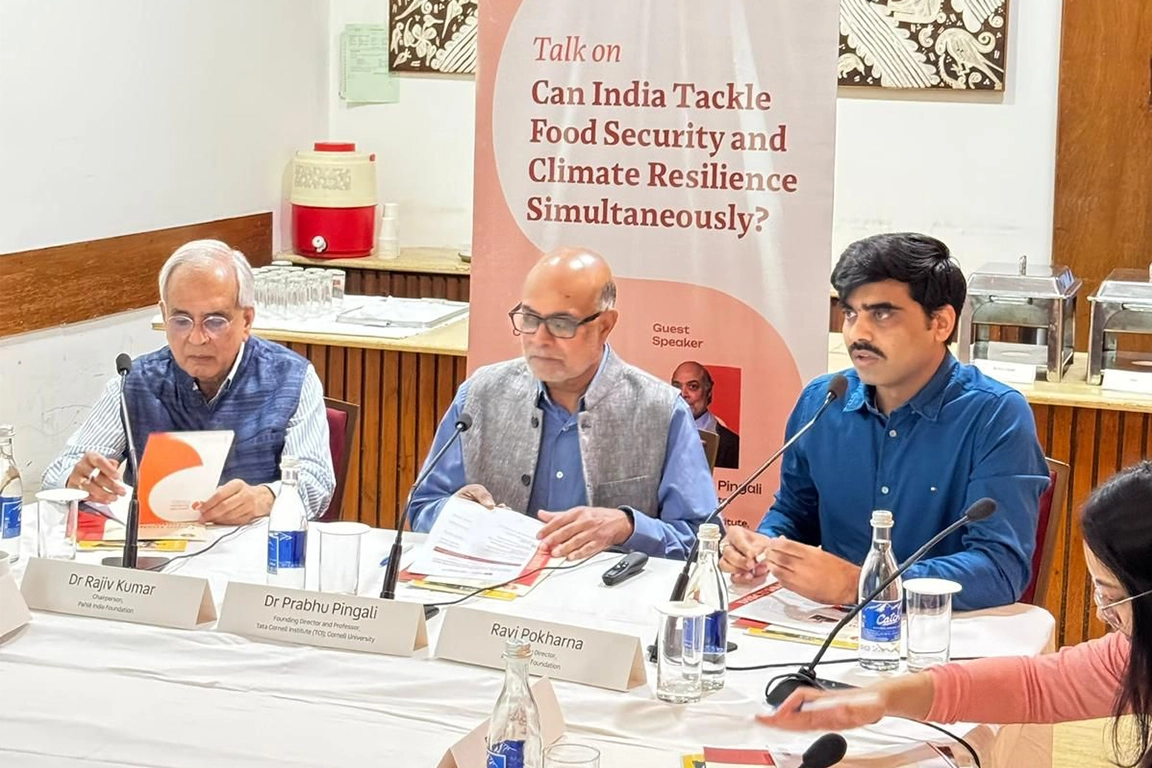
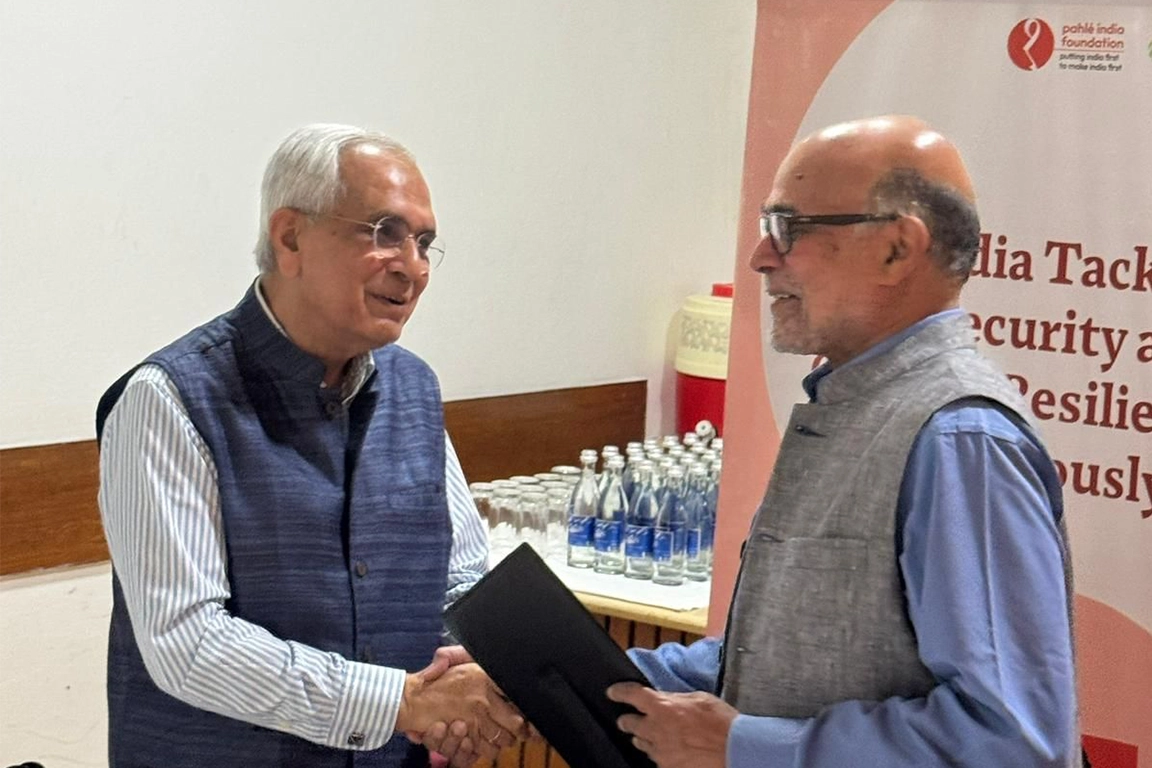
At Pahlé India Foundation, we explored this critical question at a policy dialogue with Dr Prabhu Pingali, titled “Can India Tackle Food Security and Climate Resilience Simultaneously?” —co-hosted with the Tata-Cornell Institute for Agriculture and Nutrition (TCI) at the India International Centre.
As India advances toward Viksit Bharat 2047, the path runs directly through its farms. With millions dependent on rural livelihoods, transforming agriculture is not just an economic priority — it is the foundation of inclusive and resilient growth.
The room was filled with sharp insights and probing questions. Here are a few key takeaways:
- Dr. Prabhu Pingali, one of the world’s most-cited agricultural economists and Director of TCI, challenged us to rethink productivity — not just in terms of yield, but also in terms of climate resilience and nutritional outcomes.
- Dr. Rajiv Kumar, Chairperson of Pahlé India Foundation, reminded us that “Putting India First” means designing policies that protect both farmers and the planet — simultaneously, not sequentially.
The discussion highlighted a crucial reality: India’s agro-climatic diversity demands localized, data-driven solutions — not one-size-fits-all policies.
India’s journey toward Viksit Bharat 2047 is closely tied to the transformation of its agricultural sector. With a large share of the population dependent on rural livelihoods, improving agricultural productivity, farmer incomes, and sustainability is essential for inclusive growth.
Key insights:
- Agriculture at the centre of development
Boosting productivity and farmers’ incomes is critical for achieving Zero Hunger and strengthening rural economies.
- India’s dual nutrition challenge
The country faces both undernutrition and rising obesity, highlighting the need to shift toward nutrient-rich foods.
- Regional disparities
Food insecurity, poverty and malnutrition are region-specific challenges
What is needed:
- Balancing food security and climate goals
Agricultural transformation will require:
- Smart farming (efficient use of water, fertilizers, energy)
- System diversification: shifting from the conventional rice–wheat system toward pulses, oilseeds, millets, vegetables, and diversified livestock systems.
- Cross-sector solutions such as agrovoltaics
- Policy change
Siloed decision-making, subsidy structure, incentive system, value chain and weak coordination across governance levels
Takeaway for Policy makers:
- Achieving food & nutritional security, climate resilience, and farmer prosperity will require policy convergence, innovation, and localized farming approaches.
- Promote Crop Neutral Agricultural policy
Takeaway for Scientific community:
- Need for transdisciplinary research towards generating evidence
India’s agricultural future must move from producing more staples to building better food systems.